
Business Development Research Tools
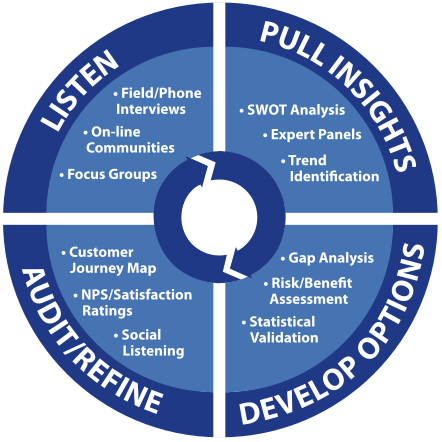
In the current environment, shelf life of market data is short.
The tools we use have evolved to match the business climate.
Evolved research tools allow us to:
- Fully frame opportunities
Listen to the whole market – not just current customers or channel partners - Capture rich data
Pull insights from qualitative and quantitative data streams, analyzing information in the context of specific objectives and outcomes - Collaborate with client teams
Identify market opportunities that should be targeted on a high-priority basis.
Fully Frame Opportunities: 360° Market Audit
Quantify market size.
Project growth.
Calculate market share.
Assess adoption of new technology and process efficiences.
Track shifts in customer perceptions.
Overview the state of the market to reveal critical trends, disrupters and enablers that influence future business resiliency.
Capture insight from 360° field research to develop a compelling business case for change and determine how to capitalize on opportunities.
Analysis includes feedback from channels, end users, competitors, and potential alliances/collaborations.
Identify the 4 to 6 strategic steps that will concretely maximize the size and profitability of growth initiatives.
Layer where there are opportunities to grow with execution: how to achieve growth.
Assess value delivered against the organization's growth and performance KPIs.
Identifying opportunities in an ever-changing market environment requires a creative, flexible, and methodical approach. 360° market audits are instrumental to the success of this approach, integrating data from a broad reach of sources.
The 360° market audit is a Swiss Army knife, providing quantitative and qualitative evaluation of opportunity and risk associated with growth. It identifies options with high growth potential and options to de-emphasize—areas that require a more cautious approach or reduced investment.
Capture Rich Data: Purchase Journey Mapping
Build detailed, AI-assisted profiles of target customer segments that embody distinctive psychographics such as interests, motivations, and pain points.
Overview the state of the market to reveal critical trends, disrupters and enablers that influence future business resiliency.
Capture insight from surveys, field interviews, focus groups, online reviews. Analyze targets’ expectations and satisfaction at each touchpoint and journey stage.
Recommend potential solutions and improvements that address gaps and enhance CX. This may involve refining marketing strategies, positioning, enhancing customer support processes such as demos, training, onboarding, and virtual sales tools.
Continuously monitor and evaluate Journey Map for consistent communication touchpoints pre- and post-purchase.
In this environment of high change, buyers’ risk of making poor purchase decisions increases. To mitigate uncertainties, buyers often engage in extensive research to evaluate potential vendors and solutions. Abundance of information can lead to information overload, making it difficult for buyers to sift through and make informed decisions. Furthermore, the decision-making process may involve multiple stakeholders, which can contribute to decision inertia.
Customer journey maps break down buyers' purchase obstacles by enriching CX at each step of the purchase journey—optimizing interactions, driving innovation, and fostering brand advocacy.
Collaborate with Client Teams: Market Benchmarking
Use value chain analysis, data visualization, and other analytics to define strengths, weaknesses, opportunities, and threats (SWOT).
Identify the market opportunities and threats with the greatest destabilizing potential.
Develop alternative future scenarios to avoid reactive, late-to-market response. Run stress tests. Explore potential outcomes and their implications.
Use updated tap lines on trends to invest in resilient, agile, and sustainable solutions. Accelerate results with strategic alliances and collaborations.
Translate vision and strategy to operational objectives. Measure success across four perspectives: financial, customer, internal processes, and learning & growth.
Herd mentality is safe—but hardly the mindset of a leader. Organizations that actively invest in resilient, agile, and sustainable solutions outpace competitor rivals.
Market benchmarking is foundational to assess current strategic position, inform future action, and sustain long-term growth.